

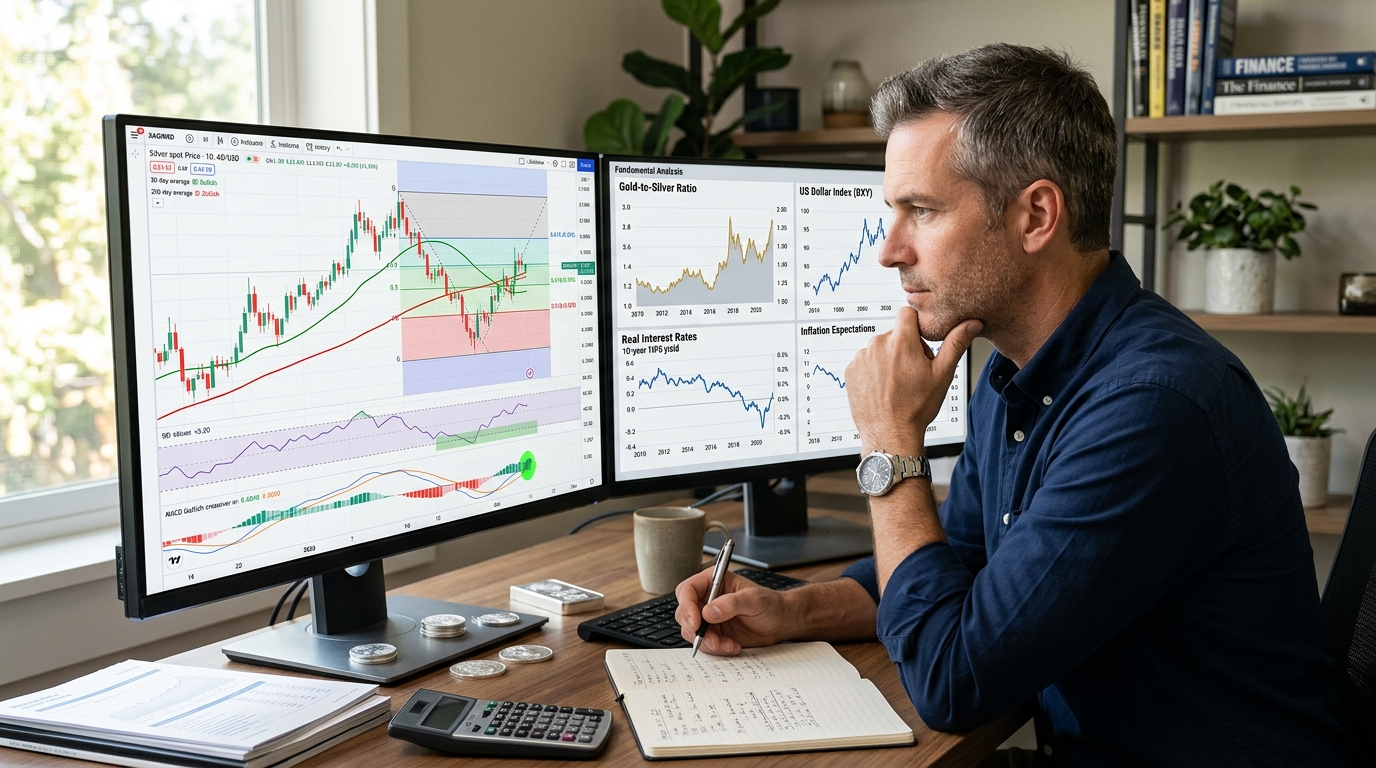
Understanding silver buying timing indicators can dramatically improve how you approach investing in silver. Instead of guessing when to enter the market, you begin to rely on clear signals that reflect real market behavior. While many beginners focus only on price, experienced investors look deeper. They analyze patterns, momentum, and economic conditions to make better decisions.
At first, silver buying timing indicators may seem complex. However, once you break them into simple concepts, they become easier to use. More importantly, they help remove emotional decision-making. Instead of reacting to price swings, you respond to structured signals. In this guide, you will learn how to use silver buying timing indicators effectively so you can enter the market with greater confidence.
Why Timing Matters In Silver Investing
Timing plays a crucial role in determining the success of your investment. While silver has long-term value, buying at the wrong moment can reduce your returns. Therefore, understanding silver buying timing indicators helps you improve both entry and risk management.
For example, entering the market during a strong upward move may seem attractive. However, this often means buying near a short-term peak. On the other hand, waiting for better conditions can provide a more favorable price. This is where silver buying timing indicators become valuable.
By focusing on timing, you avoid chasing the market. Instead, you position yourself strategically. Over time, this approach leads to more consistent results and greater confidence.
Understanding Trend Direction First
Before applying any tools, it is important to understand the overall trend. Silver buying timing indicators work best when aligned with the market’s direction. Without this context, signals can become misleading.
An uptrend shows higher highs and higher lows. In this case, buying during pullbacks is often more effective. Conversely, a downtrend indicates weakness, suggesting that patience may be the better option.
By identifying the trend first, you create a foundation for using silver buying timing indicators correctly. This simple step helps filter out poor signals and improves decision-making.
Using Moving Averages For Clear Signals
Moving averages are among the most reliable silver buying timing indicators. They smooth out price data and highlight the overall trend. This makes it easier to identify when the market is gaining or losing strength.
For instance, when the price stays above a moving average, it often signals upward momentum. When it falls below, it may indicate weakness. Crossovers between short-term and long-term averages can also provide entry signals.
While moving averages are simple, they are powerful. They help you avoid emotional decisions and focus on data-driven insights. As a result, they remain a key component of effective silver buying timing indicators.
RSI And Overbought Or Oversold Conditions
The relative strength index, or RSI, is another important tool among silver buying timing indicators. It measures momentum and helps identify whether silver is overbought or oversold.
When RSI rises above a certain level, it suggests that prices may be overextended. This could signal a potential pullback. On the other hand, a low RSI indicates oversold conditions, which may present buying opportunities.
However, RSI should not be used alone. It works best when combined with trend analysis. By integrating RSI into your strategy, you strengthen your understanding of silver buying timing indicators.
MACD For Momentum And Trend Changes
The MACD indicator provides insights into both momentum and trend direction. It is one of the more advanced silver buying timing indicators, but it becomes easier with practice.
MACD shows the relationship between two moving averages. When the lines cross, it can signal a change in momentum. This helps you identify potential entry points before trends become obvious.
Additionally, divergence between MACD and price can indicate weakening momentum. This may signal a reversal. By using MACD alongside other tools, you can refine your silver buying timing indicators and improve accuracy.
Support And Resistance As Key Levels
Support and resistance levels are essential components of silver buying timing indicators. These levels represent areas where prices tend to reverse or pause.
Support acts as a floor where buying interest increases. Resistance acts as a ceiling where selling pressure emerges. By identifying these zones, you can improve your timing significantly.
For example, buying near support reduces risk because prices have a higher chance of stabilizing. Avoiding resistance levels helps prevent buying at inflated prices. Over time, these levels become critical in applying silver buying timing indicators effectively.
Volume As A Confirmation Tool
Volume is often overlooked, but it plays a key role in confirming signals. Strong price movements with high volume indicate strong participation. This adds credibility to the trend.
When using silver buying timing indicators, volume helps validate your analysis. For instance, a breakout above resistance with high volume suggests strong demand. Conversely, weak volume may signal a false move.
By paying attention to volume, you gain an additional layer of insight. This strengthens your ability to interpret silver buying timing indicators accurately.
Combining Indicators For Better Results
No single indicator is perfect. Therefore, combining multiple silver buying timing indicators often produces better results. This approach allows you to confirm signals and reduce risk.
For example, you might use moving averages to identify trends, RSI to measure momentum, and support levels to determine entry points. When these signals align, the probability of success increases.
However, simplicity is still important. Using too many indicators can create confusion. Focus on a few reliable tools and apply them consistently. This balanced approach enhances your use of silver buying timing indicators.
Avoiding Common Timing Mistakes
Even with strong tools, mistakes can happen. One common error is relying too heavily on a single indicator. This can lead to misleading signals.
Another mistake is ignoring the broader market context. Indicators work best when combined with economic insights and trends. Without this context, signals may lose reliability.
Additionally, emotional decision-making remains a major risk. Fear and greed can override logic, leading to poor timing. By staying disciplined, you can avoid these pitfalls and improve your use of silver buying timing indicators.
Building A Consistent Strategy
Consistency is key when applying silver buying timing indicators. Instead of constantly changing your approach, develop a clear strategy and stick to it.
For example, define your entry criteria based on specific signals. This could include a pullback in an uptrend combined with an oversold RSI. By setting clear rules, you reduce uncertainty.
Over time, this consistency builds confidence. You begin to trust your process and make decisions more efficiently. This is one of the most important benefits of using silver buying timing indicators.
Developing Confidence Through Practice
Confidence comes from experience. The more you use silver buying timing indicators, the better you become at recognizing patterns and signals.
Start with simple tools and gradually expand your knowledge. Track your decisions and review the outcomes. This helps you learn from both successes and mistakes.
With time, what once seemed complex becomes intuitive. You begin to see the market more clearly and act with greater confidence. This progression is essential for mastering silver buying timing indicators.
Conclusion: Turning Indicators Into Smart Decisions
Silver buying timing indicators provide a structured way to approach the market. Instead of relying on guesswork, you use data and patterns to guide your decisions. By combining trend analysis, momentum indicators, and key levels, you create a reliable framework.
While no method guarantees perfect timing, using these indicators improves your odds. More importantly, it helps you stay disciplined and avoid emotional mistakes.
Ultimately, mastering silver buying timing indicators allows you to move from uncertainty to clarity. With practice and consistency, you can turn these tools into a powerful advantage that supports smarter and more confident investing.
FAQ
1. What are the most important tools for timing silver purchases?
Moving averages, RSI, and support levels are among the most commonly used tools.
2. Can beginners use technical indicators effectively?
Yes, starting with simple indicators and practicing regularly can lead to strong results.
3. Is it necessary to use multiple indicators together?
Combining indicators often improves accuracy, but simplicity should always be maintained.
4. How do I know if a signal is reliable?
Look for confirmation from multiple sources, such as trend direction and volume.
5. Should timing be the only factor when buying silver?
No, combining timing with long-term strategy and market understanding is more effective.